Skip to main content
Working with colleague George Alexander, a Mvskoke Creek artist who paints under the name “Ofuskie,” Romero depicts him as the man in the blue spacesuit, complete with a retro, 1960s era helmet, drifting past the stars and corn, merging past and the hope for robust survival in the future.
Like "The Zenith", which can reference the highest point a celestial body can make in its visible orbit or the name of a vintage TV brand that brought science fiction such as Star Trek in to people’s homes, Romero’s body of work subverts expectations of what Native people are and where they are going, but still remains grounded in an Indigenous worldview. The continuous cultivation of corn, she argues, is an example of the sophisticated science and knowledge of the environment embedded in Native lifeways that will help humanity in the future.






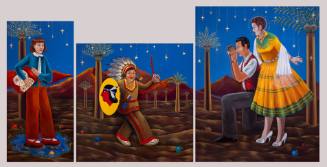


The Zenith
Artist
Cara Romero
(Chemehuevi, born 1977)
Date2022
Dimensionsimage: 40 x 45 in. (101.6 x 114.3 cm)
ClassificationsART, 2-DIMENSIONAL
Credit LineMuseum Purchase with the Robert and Hertha Rockwell Deaccession Fund
Object number2025.15
DescriptionA man seems to float against a star-lit universe in a space suit and helmet, improbably surrounded by ears of corn. This image, at once humorous and thought-provoking, exemplifies the work of the artist. Known for her work in the burgeoning genre of “Indigenous Futurism,” Romero argues that her work links “fun, fantasy, and hope,” with the reminder that as Native people, “we take our past with us.”Working with colleague George Alexander, a Mvskoke Creek artist who paints under the name “Ofuskie,” Romero depicts him as the man in the blue spacesuit, complete with a retro, 1960s era helmet, drifting past the stars and corn, merging past and the hope for robust survival in the future.
Like "The Zenith", which can reference the highest point a celestial body can make in its visible orbit or the name of a vintage TV brand that brought science fiction such as Star Trek in to people’s homes, Romero’s body of work subverts expectations of what Native people are and where they are going, but still remains grounded in an Indigenous worldview. The continuous cultivation of corn, she argues, is an example of the sophisticated science and knowledge of the environment embedded in Native lifeways that will help humanity in the future.
Collections
- Native Now
Not on view
Gutierrez, Martine
2018